A Newcastle crane company was using an 80-tonne all terrain crane to support a vibratory piling attachment when structural damage occurred to two boom sections. Peter Tighe, who was Workshop Manager at the time, was tasked with having the machine repaired.
Peter searched the globe for a device that could be used between the crane and vibratory piling attachment to reduce the vibration and shock being transferred through to the crane.
After months of research Peter came to the conclusion there were no commercial solutions available that reduced a substantial proportion of the vibration. He then thought that he would look for a solution himself. Transport suspensions provided the inspiration.
“I placed a half-full plastic cup of coffee down on the chassis rail of a 97-tonne electric motor that was being loaded for travel from Sydney to Adelaide, so that I could chain the load.I forgot about it and when I was unchaining the load at the destination, I discovered the coffee where I had left it still half full but with a thick layer of dust on top of it. That gave me an appreciation of how good hydraulic suspension was at dampening shock.
That was in the early 1990’s and by the time of the crane accident, pneumatic suspension was regarded as the new benchmark. I thought that technology would be better than hydraulics for the piling application as it would be easier to change dampening frequencies as well as more responsive and simpler to work with”
Peter Tighe
Developer of Neva-Shock


Construction of the first prototype was completed in 2010 and tested in June of that year. SLR Consulting was engaged to provide independent testing of the results of those trials, and has continued to provide these services through to the completion of the pre-production model in 2018.
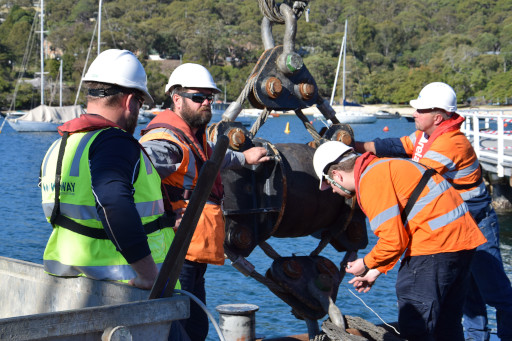
A principle of the first prototype, which has continued through to the production model, is that there is no direct structural connection between the crane and the vibratory piling attachment. There are plates above and below the air bags, with the bottom plate connected to the crane and the top plate connected to the piling attachment.
In the unlikely event of a catastrophic failure of the airbags, the bottom plate would then support the top plate so that the load remained secure.
Analysis showed vibration peaks at start-up and shutdown, and a steady state during operation. The first prototype significantly reduced the start-up and shutdown peaks but had minimal impact on the steady state operation. Subsequent prototypes improved the vibration reduction at start-up and shutdown (up to 93% on land and 90% on water) and also reduced steady state vibration